# SAST Issue

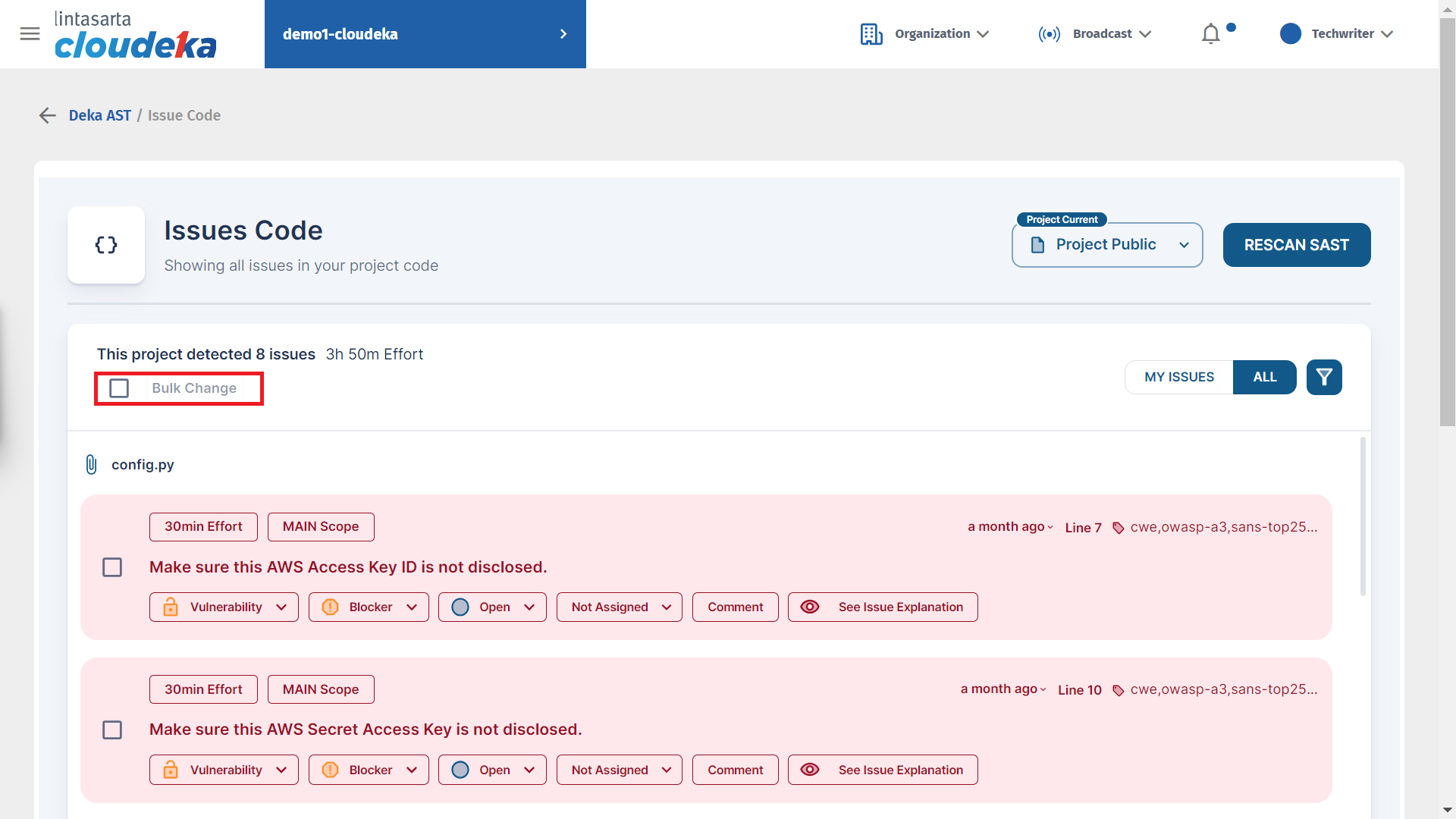
The Issue Code page displays all problems in your project repository.

<figure><img src="https://putri.box.cloudeka.id/cloudeka-assets/static/images/19dekaast/5.0issuecode.png" alt=""><figcaption><p>Issue Code</p></figcaption></figure>

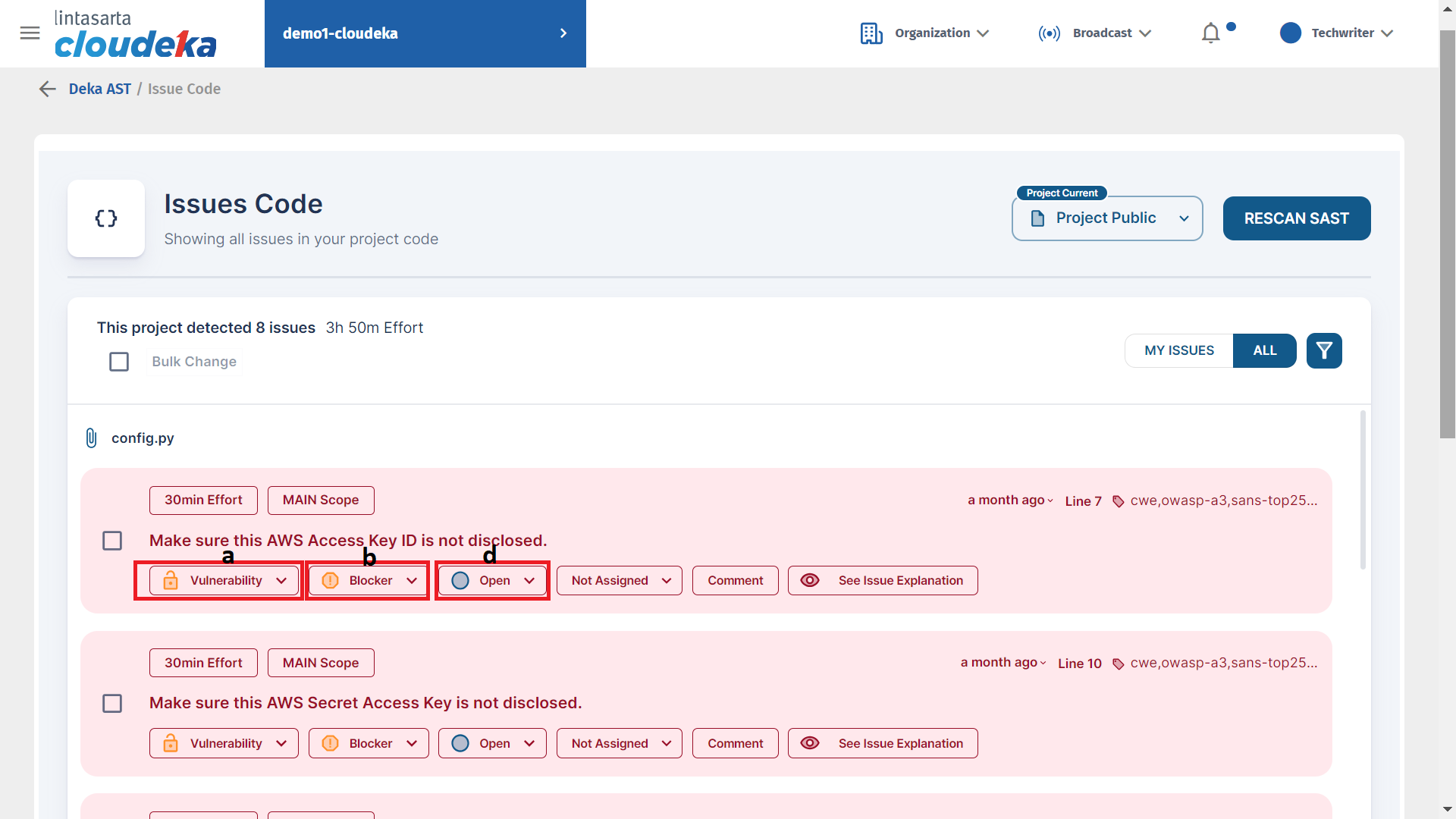
The Issue Code page displays the issue on your project.\
a. Type displays the type of problem code.

<table><thead><tr><th width="160">Column</th><th>Description</th></tr></thead><tbody><tr><td><strong>Code Smells</strong></td><td>An indication in the source code that indicates a possible problem in the implementation.</td></tr><tr><td><strong>Bug</strong></td><td>A failure in software that results in behavior that does not match the expected specifications.</td></tr><tr><td><strong>Vulnerability</strong></td><td>A vulnerability in repository code that an attacker can use to access in an unauthorized.</td></tr></tbody></table>

b. Severities display the severity category of the issue code that occurred.

<table><thead><tr><th width="154">Column</th><th>Description</th></tr></thead><tbody><tr><td><strong>Blocker</strong></td><td>Bug with a high probability of impacting the behavior of the application in production.</td></tr><tr><td><strong>Critical</strong></td><td>Either a bug with a low probability of impacting the behavior of the application in production or an issue that represents a security flaw.</td></tr><tr><td><strong>Minor</strong></td><td>Problems arise that have a relative impact on system functionality.</td></tr><tr><td><strong>Major</strong></td><td>Problems arise that have a significant impact compared to minor problems, which can affect user experience, performance and therefore need to be addressed.</td></tr><tr><td><strong>Info</strong></td><td>Displays additional information that does not belong to the problem category. It can be used to provide an explanation of the code.</td></tr></tbody></table>

\
c. Status displays the state of an issue in the problem code.

<table><thead><tr><th width="227">Column</th><th>Description</th></tr></thead><tbody><tr><td><strong>Open</strong></td><td>Set on new issues.</td></tr><tr><td><strong>Confirmed</strong></td><td>Displaying the issue state has been confirmed by the developer so that the problem exists in the process of resolving.</td></tr><tr><td><strong>Resolve (Fixed)</strong></td><td>Displays the state the issue has been considered and the solution has been applied so that this state is considered resolved.</td></tr><tr><td><strong>Resolve (False Positive)</strong></td><td>Displaying the previously reported state of the issue turns out to be no problem so it is considered unnecessary to fix it.</td></tr><tr><td><strong>Resolve as won’t fix</strong></td><td>Showing the state of the issue has been confirmed so that the problem state persists but is agreed not to be fixed.</td></tr></tbody></table>

\
You can effectively change issues to multiple files in the repository by following these steps:

* On the Issue Code page check the problem code.

<figure><img src="https://putri.box.cloudeka.id/cloudeka-assets/static/images/19dekaast/5.1%20bulk.png" alt=""><figcaption><p>Bulk Change (a)</p></figcaption></figure>

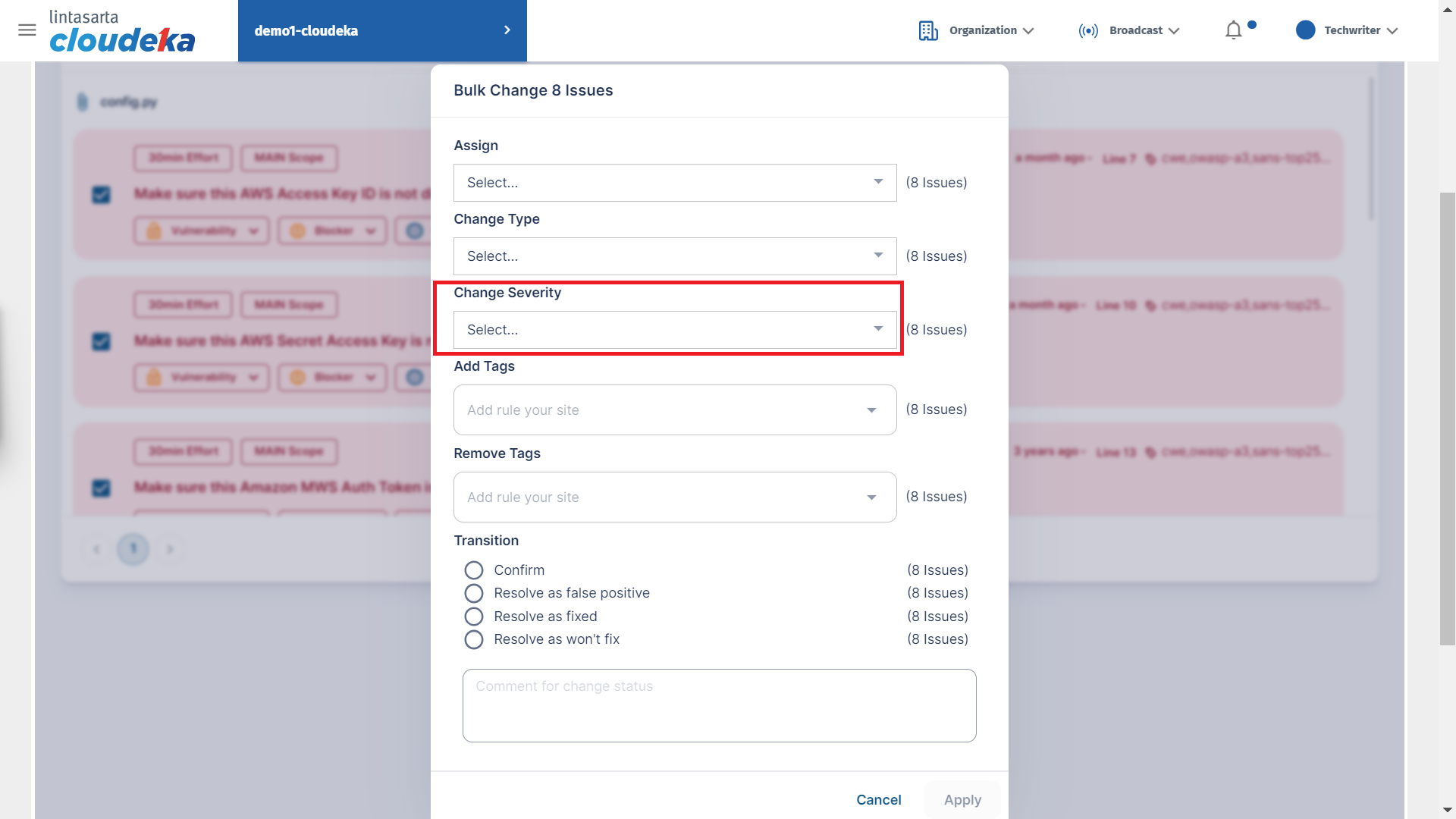
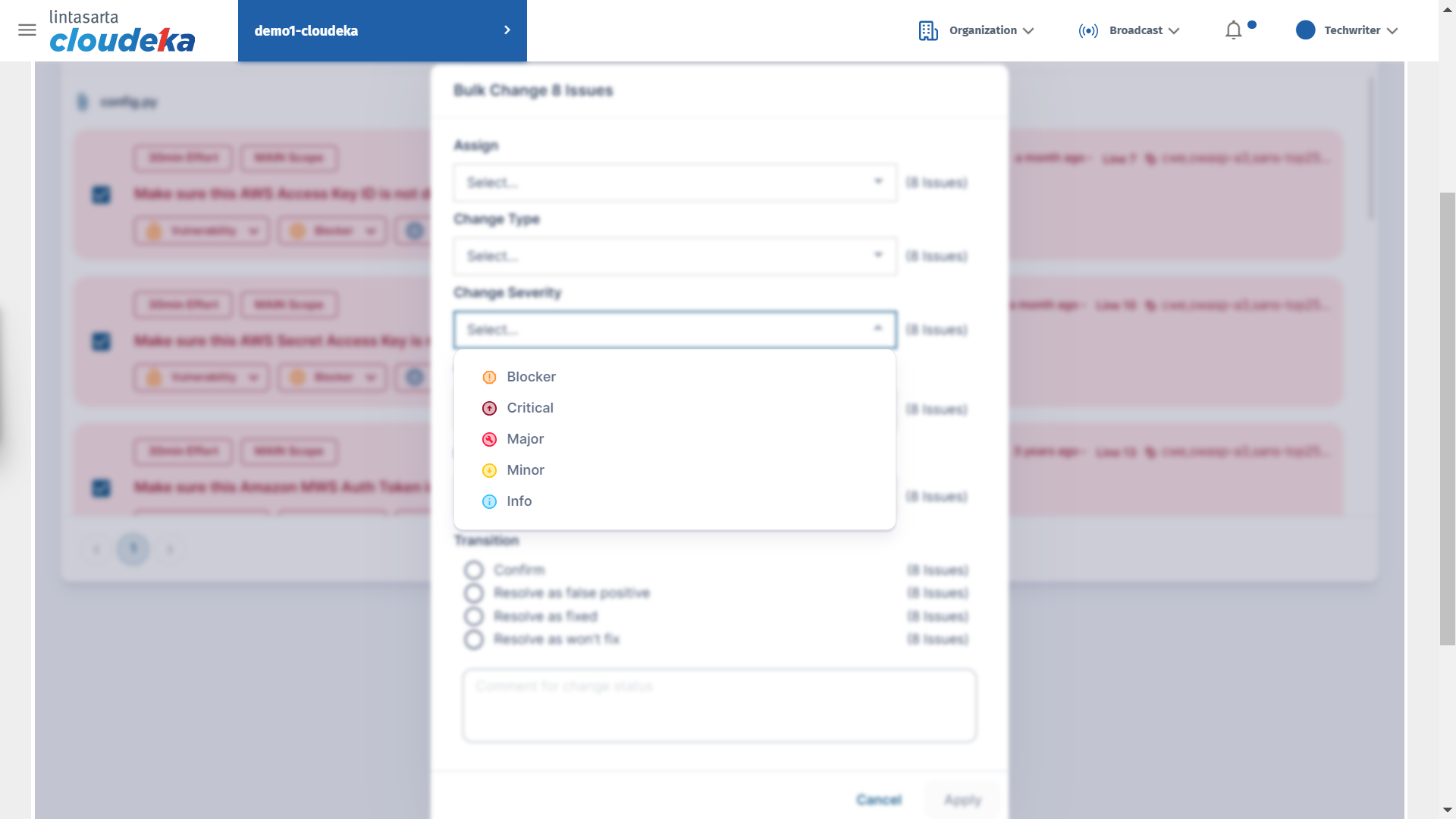
* Display the Bulk Change form, in the Change Severity column, select the condition to change simultaneously and click the Apply button to save the changes.

<figure><img src="https://putri.box.cloudeka.id/cloudeka-assets/static/images/19dekaast/5.2.png" alt=""><figcaption><p>Bulk Change (b)</p></figcaption></figure>

<figure><img src="https://putri.box.cloudeka.id/cloudeka-assets/static/images/19dekaast/5.3.png" alt=""><figcaption><p>Bulk Change (b)</p></figcaption></figure>